In May 2026, at Seanergy in Nantes, Iberdrola and the maritime cluster Pôle Mer Bretagne Atlantique unveiled the three winning projects in the second call for expressions of interest under the IBReizh programme, devoted this year to the security and surveillance of offshore infrastructures. Relaunched in 2025, this programme, funded by Ailes Marines (Iberdrola) and jointly led by the Brittany Region, supports innovative solutions to protect offshore infrastructures, during both construction and operation. Three projects were selected for this call: SEAWARD (Quiet Oceans/CLS), SEAOWL (SeaOwl) and MAESTRO (Nanocode). Delve deeper into these projects through a series of three portraits brought to you by Bretagne Ocean Power.
A wealth of international maritime expertise. SeaOwl has been charting its course from the Gulf of Guinea to the coast of Brittany. This French group was founded in 2008 as a ship management company, providing vessels and crew to its clients, before gradually expanding its scope towards the energy industry, then towards new maritime surveillance technologies.
While the firm is headquartered in Levallois-Perret, some of its 2,000 employees are based in Brest, where the company runs its maritime services, which have historically focused on the defence sector.
An energy-focused group
SeaOwl organises its business around three key areas: maritime services (fleet and crew management), the provision of specialist personnel for the energy sector, and the development of new technologies for maritime surveillance and drone services, under its subsidiary SeaOwl Technology Solutions (STS), which specialises in autonomous systems, cybersecurity and robotics.
In Brest, where the team focuses on maritime operations and the defence sector, the SEAOWL project is an unprecedented pathway into offshore renewable energy, in direct collaboration with engineers at the STS subsidiary based in Ollioules.
SeaOwl has traditionally operated in the oil and gas sector but began to expand into the offshore renewable energy sector in 2016–2017, with its first contracts in UK offshore wind farms. “Marine renewable energy, in its broadest sense, is a strategic development focus for the group,” confirms Teddy Tassier, MRE Director at SeaOwl. “All our service lines can be represented within this sector. For a company like ours, it’s an excellent opportunity to showcase what we do.” This new focus represents a natural shift, as SeaOwl’s long-standing clients are also committing to the energy transition and to the deployment of offshore farms in France.
SEAOWL: Unmanned vessels, a new maritime development opportunity
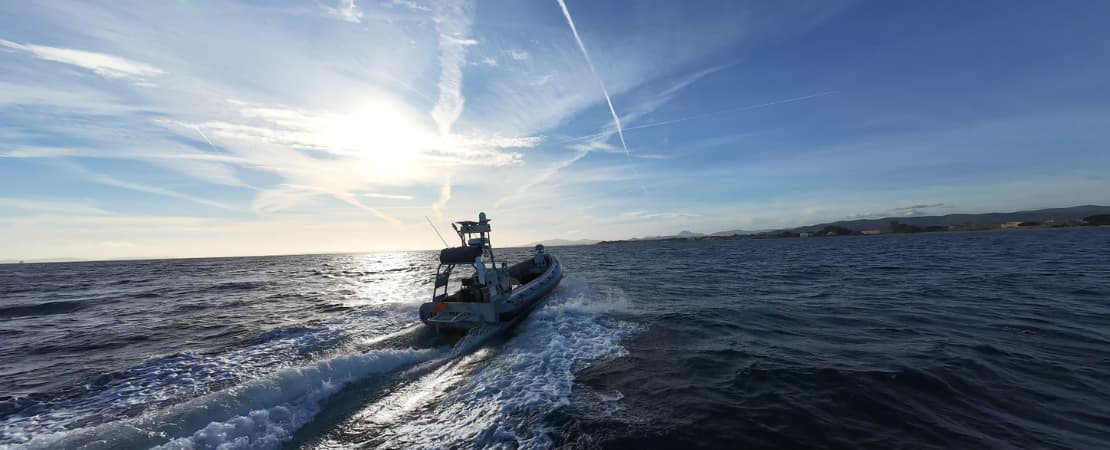
As part of the IBReizh programme, the SeaOwl group is developing the SEAOWL project: a remotely operated USV (Unmanned Surface Vehicle) designed to ensure the surveillance and security of the Saint-Brieuc offshore wind farm.
This project has a three-fold purpose: to reduce operating costs, improve human safety at sea and reduce the environmental impact of surveillance missions.
It follows on from InSPEAR project (Innovative Nautical Safety & Protection by Enhanced Autonomous Reconnaissance), which consisted in developing a USV and deploying it in Western Africa for an international oil operator, against a backdrop of maritime piracy. This entirely remotely operated vessel provides continuous surveillance of offshore structures via VMAS (Vessel Monitoring & Alert System), which compiles the AIS data from all vessels authorised in the area. Any deviation from defined routes, unknown vessel or suspicious approach automatically triggers a series of escalating alerts, potentially leading to physical intervention by the remotely operated vessel.
This system is based on SeaVAS, a containerised command centre, and on artificial intelligence algorithms capable of detecting intrusions, high-risk trajectories and abnormal behaviour in real time.
In the case of the Saint-Brieuc wind farm, the solution is tailored to a different context: a smaller vessel, whose key mission is the continuous surveillance of the wind farm and interaction with maritime users. “The crew and captain are at the helm, but behind a desk, and can pick up the radio and communicate with the vessel in real time,” explains Teddy Tassier. If a fishing vessel ventures outside its authorised area or a pleasure craft comes too close to a wind turbine, the USV will approach the vessel to inform it and ask it to turn around.
“A presence within the wind farm 24/7 also helps to deter malicious activity,” he adds.
Thanks to the IBReizh funding, of up to €100,000 and covering 50% of eligible costs, SeaOwl is able to devote engineers’ time to adapting these technologies to the specificities of offshore renewable energy. This project offers the opportunity to bring together two of the company’s different teams: the maritime services personnel in Brest and engineers specialised in new technologies based in Ollioules. “For this project, we will be combining the skills of different teams,” emphasises Teddy Tassier.
Saint-Brieuc as a showcase, Brittany as a springboard
For SeaOwl, this call is more than just a technical demonstration. Tenders in this sector are not yet designed to include unmanned vessels. It is essential to demonstrate that this is an effective solution, to bring about changes in specifications.
The demonstrator will be deployed in the port of Saint-Quay-Portrieux for a two-month period. “It’s very beneficial for a French company to be able to monitor its projects in France, and not just in Congo, Gabon or Nigeria,” acknowledges Teddy Tassier.
The Saint-Brieuc offshore wind farm, a recognised showcase for French offshore wind power, offers SeaOwl valuable exposure to assert its credibility in a rapidly expanding market. A gateway to new opportunities.