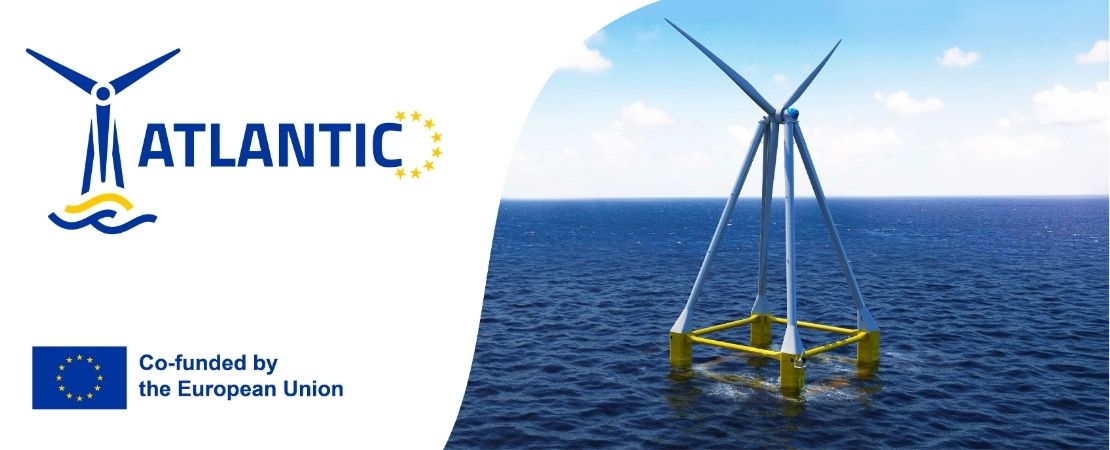
Making floating wind power a competitive and sustainable European industry, that is the challenge facing the Horizon Europe Atlantic project. Launched in October 2025 for a period of four years, this European project brings together 13 industrial and academic partners from 6 countries to promote cheaper and less impactful floating wind power solutions.
Towards a competitive and sustainable European floating offshore wind energy sector
As a beneficiary of the Horizon Europe programme, allocated €15 million in funding, the Atlantic project — led by Eolink and the Valorem Group — aims to reduce energy production costs for large-scale floating wind.
Atlantic stands for : Advancing Technological Leap in the Area of floating offshore wind turbines Needed for a Transition to Innovative Clusters of green energy
With a first-rate European consortium comprising 13 partners from 6 countries, the project seeks to significantly reduce electricity production costs while curbing CO₂ emissions.
To do so, the Atlantic project will demonstrate the performance of an innovative 5 MW floating unit developed by Eolink, deployed at the SEM-REV test site off the French Atlantic coast, with a target levelised cost of energy (LCOE) of €85/MWh by 2030, and a projected LCOE of €57/MWh beyond 2035.
Its innovative design is expected to reduce carbon emissions compared to current market standards and will include extensive environmental monitoring.
The Atlantic project will also lay the groundwork for establishing a European supply chain, an important prerequisite for the large-scale roll-out of floating offshore wind and enhanced energy sovereignty within Europe.
The consortium, featuring a strong industrial component, brings together 4 businesses and SMEs, 1 public interest foundation, 6 research centres, 1 university and 1 regional organisation.
Project focus topics
From October 2025 to October 2029, the Atlantic project will be rolled out in several phases:
– 5 MW FOWT Final Development and Deployment Phase
– 5 MW FOWT Operation Monitoring and Maintenance
– Environmental Monitoring & Impact Assessment
– Design Optimisation of the FOWT
– Exploitation & Scale-up to multi-MW farms
– EU Supply Chain & Industrialisation studies for large-scale deployment of FOWT farms
– Communication, Dissemination and Regional Acceptance
copyright : ©Ludys for Eolink
Project partners

– Valorem (France): Valorem is an independent green energy operator, a vertically integrated group involved in every stage of a renewable energy project.
– Eolink (France): Eolink is a small industrial company based in Brest, France, developing a technology that is unique in the world, specifically designed for floating wind turbines.
– Valemo (France): Valemo is a recognized independant service provider working on many different project from demonstration phase to commercial operation of renewable energy farms.
– Fondation OPEN-C (France): The mission of Fondation OPEN-C is to operate the 5 French offshore test sites for floating wind turbines and marine renewable energy, to monitor the environmental impact of the projects and to contribute to the development of the sector.
– Ifremer (France): The French Research Institute for Exploitation of the Sea, Ifremer contributes, through its work and expertise, to knowledge of the oceans and their resources, to the monitoring of the marine and coastal environment, and to the sustainable development of maritime activities.
– Agence Bretagne Next (France): The Bretagne Next agency is the economic development agency for the Brittany region. Its mission is to anticipate, structure and promote economic sectors of the future. In the field of offshore renewables energies, it leads the Bretagne Ocean Power collective, which brings together all of Brittany’s ORE stakeholders within a single entity, thereby promoting more efficient industrial projects.
– Dutch Marine Energy Centre (DMEC) (Netherland): DMEC is an accelerator and knowledge centre for offshore renewable energy solutions.
– RISE Research Institutes of Sweden (Sweden): RISE Research Institutes of Sweden is Sweden’s research institute and innovation partner
– Institut de la corrosion (France): The Corrosion Institute is a corrosion research and expertise laboratory affiliated with RISE.
– Fraunhofer-Gesellschaft (Germany): The Fraunhofer-Gesellschaft is one of the world’s leading applied research organisations, including the Fraunhofer Institute for Large Structures in Production Engineering IGP and the Fraunhofer Institute for Wind Energy Systems IWES, which conducts application-oriented research for a sustainable future.
– SINTEF Ocean (Norway): SINTEF Ocean is an independent research institute within the SINTEF Group that develops technologies, models, and digital tools for sustainable ocean-based industries. Offshore wind energy is a key focus area for SINTEF Ocean.
– National Technical University of Athens (NTUA) (Greece): The School of Civil Engineering at the National Technical University of Athens, sometimes referred to as the Athens Polytechnic, is internationally recognised.
– Syntropie (France): Syntropie specialises in managing complex research and innovation projects funded by the European Union.
News
On 22 and 23 October 2025, the Atlantic project partners met in Brest for the project’s kick-off meeting. The constructive discussions held during this two-day event illustrate the cooperation mindset and the shared commitment of the entire consortium towards cementing floating wind as a pillar of the European energy transition.
Latest newsContact
You have a question regarding the Atlantic project or would like to contact one of the partners of the project ? Please use the contact form below.
Contact usA Horizon Europe project
This project is co-funded by the European Union under the Horizon Europe research and innovation programme.
Find out more about CINEA‘s activities: European Climate, Infrastructure and Environment Executive Agency.
Co-funded by the European Union. Views and opinions expressed are however those of the author(s) only and do not necessarily reflect those of the European Union or CINEA. Neither the European Union nor the granting authority can be held responsible for them.
Grant Agreement number: 101235705