In May 2026, at Seanergy in Nantes, Iberdrola and the maritime cluster Pôle Mer Bretagne Atlantique unveiled the three winning projects in the second call for expressions of interest under the IBreizh programme, devoted to the security and surveillance of offshore infrastructures. Relaunched in 2025, this programme, funded by Ailes Marines (Iberdrola) and jointly led by the Brittany Region, supports innovative solutions to protect offshore infrastructures, during both construction and operation. Three projects were selected: SEAWARD (Quiet Oceans/CLS), SEAOWL (SeaOwl) and MAESTRO (Nanocode). Delve deeper into these projects through a series of three portraits brought to you by Bretagne Ocean Power.
Offshore wind farms are not enclosed industrial sites. They are not fenced off, have no visible boundary: they are open maritime areas, through which maintenance vessels, fishing boats, pleasure boats and shipping traffic pass. So how, in this bustling environment, can we distinguish between normal activity and suspicious behaviour? This is the question the SeaWard project – jointly led by Brest-based company Quiet Oceans and by CLS, a subsidiary of CLS – seeks to answer.
“An offshore wind farm is not an enclosed space. It is not like an industrial site on land, where the first thing we do is fence the area off. Our focus is on detecting abnormal activity,” explains Thomas Folegot, Director of Strategic Initiatives and Innovation and founder of Quiet Oceans.
Look from above, listen from below
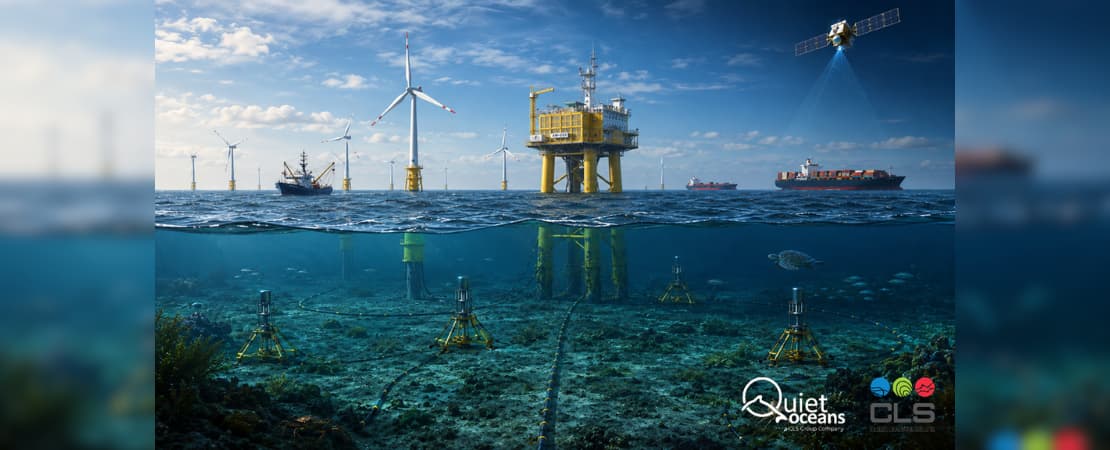
SeaWard’s solution is based on a simple yet original idea: combining radically different types of data to eliminate ambiguities. It draws on satellite imagery and AIS vessel tracking data – CLS’s field of expertise – together with subsea acoustic recordings collected by Quiet Oceans, in which it has specialised for over fifteen years.
“Most programmes have a horizontal view: they monitor either the surface or the seabed. We offer a radically different approach by looking vertically at all the layers: air, surface and underwater. It’s pretty novel,” enthuses Thomas Folegot.
The approach focuses on removing ambiguities: if the three data sources describe the same behaviour, the situation is normal. If there are divergences, an alert is triggered. Take the example of the snagging of a subsea cable, which neatly illustrates the concept: a ship is dragging an anchor across the seabed to damage a subsea cable. The satellite detects an immobile vessel, while the acoustics pick up engines running at full throttle. This conflicting information will trigger an alarm.
Proof of concept within two years
The project is currently in its first phase: a two-year proof of concept stage, based on existing archive data (acoustic recordings, satellite imagery, AIS data) collected during the construction and operational phases of the Saint-Brieuc offshore wind farm. Quiet Oceans will be developing algorithms to classify anthropogenic noise, while CLS will focus on refining the characterisation of normal vessel behaviour. The information will then be fitted together using artificial intelligence tools. Following two additional phases (a real-time flow pre-operational system, followed by operational integration), the system is expected to become fully operational around 2030.
From Saint-Brieuc to the international arena
From the outset, the ambitions of the SeaWard project, which has been awarded up to €100,000 in funding through the IBreizh programme, stretched far beyond the coastline of Brittany. “What we are doing for the Saint-Brieuc wind farm is destined, if it is successful, to become a solution on offer around the globe. CLS is present worldwide: once the solution is operational, there will be nothing to stop us expanding into the international market,” affirms Thomas Folegot.
The project remains, nevertheless, deeply rooted in Brittany. Both Quiet Oceans and the maritime security division of CLS are both based in Brest. Thomas Folegot applauds this proximity: “We were really attached to the idea of basing the company in Brittany. With everyone in the one place, it is much easier to work together on a daily basis.” A discreet yet decisive factor in fostering innovation.
Photo Credit: Quiet-Oceans