Three French higher education institutions – the Institut Polytechnique de Paris, ENSTA and the École des Ponts et Chaussées – have teamed up to launch OFFWIND. This new Master’s course with its dual-location format, based in Paris-Saclay (Champs-sur-Marne) and Brest, trains future experts in offshore wind energy.
In 2025, a new Master’s course in the offshore renewable energy sector, baptised OFFWIND, was launched. This course, opened for the 2025-2026 academic year, under the auspices of IP Paris (Institut Polytechnique de Paris), trains future operational engineers, research and development engineers and project managers for the floating and fixed offshore wind sector.
The OFFWIND Master’s course was jointly developed together with ENSTA and ENPC (École des Ponts et Chaussées), both members of IP Paris. “The two schools provide a foundation of complementary skills: maritime engineering with ENSTA and port engineering through ENPC”, explains Luc Pastur, associate professor at ENSTA and Director of the OFFWIND programme.
After completing their Master’s degree, the graduates can follow various paths: go on to do a PhD, enter the job market or specialise further by taking the “Expert in offshore renewable energy” Specialised Master’s course. “OFFWIND is clearly geared towards the industrial offshore wind sector (floating and fixed). Applicants must have an undergraduate qualification. The “Expert in offshore renewable energy” Specialised Master’s course [already offered by ENSTA, the Naval Academy, IMT Atlantique and Brest University] covers all forms of offshore energy (tidal power, wave energy, etc.) more broadly and is open to applicants with 5 or 6 years of post-secondary study.”
Academic modules in Paris, industrial immersion in Brest
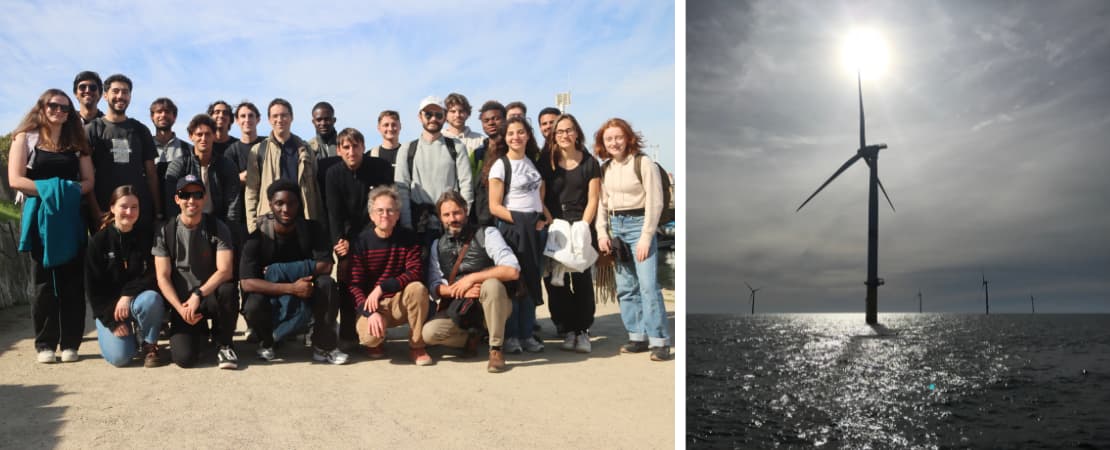
After successfully completing their first and second years of ENSTA’s engineering programme (equivalent to the first year of a Master’s degree), eight students set sail for Brest to enter the second year of the OFFWIND Master’s course.
At the tip of Brittany, they benefited from an industrial immersion programme, complete with site visits and interaction with Brittany’s industrial players. “Students are ready to make this move because it offers them a clear career path and encompasses a strong commitment towards the common good – in this case, the energy transition. They easily find internships and have the opportunity to visit the design offices of locally based companies, as well as industrial production, installation and maintenance sites. This also fosters the involvement of Brittany’s industrial sector.”
Starting in the 2026–2027 academic year, the first year of the OFFWIND Master’s course will be taught at ENSTA’s Paris-Saclay campus in Palaiseau and ENPC’s Champs-sur-Marne campus “so that students can benefit from the academic expertise of our schools and the geographical proximity to the headquarters of the sector’s major industrial players.”
In Brest, ENSTA is soon to be equipped with a dedicated test tank. “The students will be able to use it to carry out their final-year projects. Every year, a competition dubbed the Floating Wind Challenge is organised, in which teams of students design an innovative wind turbine float to optimise electricity generation in real-life wind and wave conditions. This test tank will be a major asset for preparing their entries in this competition, which is open to students on any course relating to floating wind. ENSTA also has access to IFREMER’s test tank.” This tank is set to be used from the second intake onwards and throughout the lifetime of the OFFWIND Master’s course.
Industry support for the OFFWIND course
IFREMER, based in Plouzané, is one of the many partners involved in the OFFWIND Master’s course, which was developed in collaboration with a consortium of industry partners. “They are involved in three areas: building the course by providing experts and funding internships as well as PhDs for students wishing to pursue doctoral studies in research and development.”
The course’s major partner organisations include TotalEnergies, Eiffage Metal, EDF and Siemens Gamesa. As evidence of its relevance to the sector, the course was approved by the maritime cluster Pôle Mer Bretagne Atlantique in December 2025.
These are win-win partnerships. By providing experts in offshore renewable energy to teach, companies are in direct contact with the students and can pick out potential future top talents for their companies. “Although our students can also do their internship with an SME, such as WindGlaz, based in Lorient”, adds Luc Pastur.
Response to the need for floating wind talents
The OFFWIND project came to fruition following a “Skills and Professions of the Future” call for expressions of interest issued by France’s General Secretariat for Investment (SGPI), within the framework of France 2030 projects. “Our goal, from the get-go, has been to meet a real need within the floating wind energy sector. Building wind turbines the size of the Eiffel Tower 100 km off the coast and keeping them up and running for 25 years is a major challenge. Industry is facing unprecedented environmental and technical challenges.” OFFWIND aims to train experts capable of tackling these challenges.
The OFFWIND Master’s course is designed to fill the gap in professionals with specialised floating wind training. For this, ENSTA and ENPC designed a course allowing students to graduate with a Diplôme National de Master (DNM) rather than a Master of Science and Technology, arguing that “This internationally recognised qualification is also less costly for students. The industry needs talented and well-trained young people, so we have sought to attract the best talent without putting up financial barriers.”
A new intake of students is expected to join the course for the 2027-2029 period, with students eager to take a deep dive into the world of floating wind energy. And how better to do so than through a second-year internship with a pure offshore wind player based in Brittany? Calling all local business leaders!