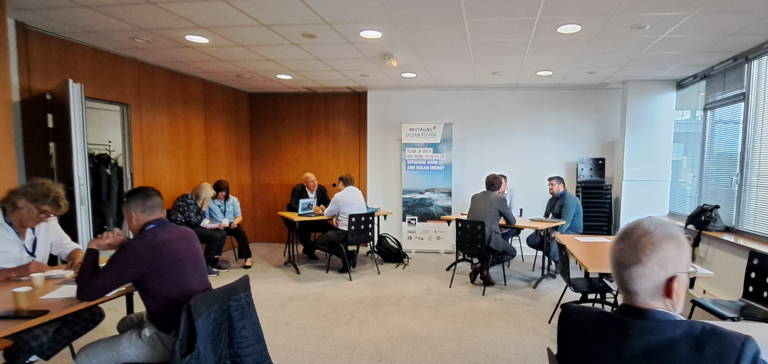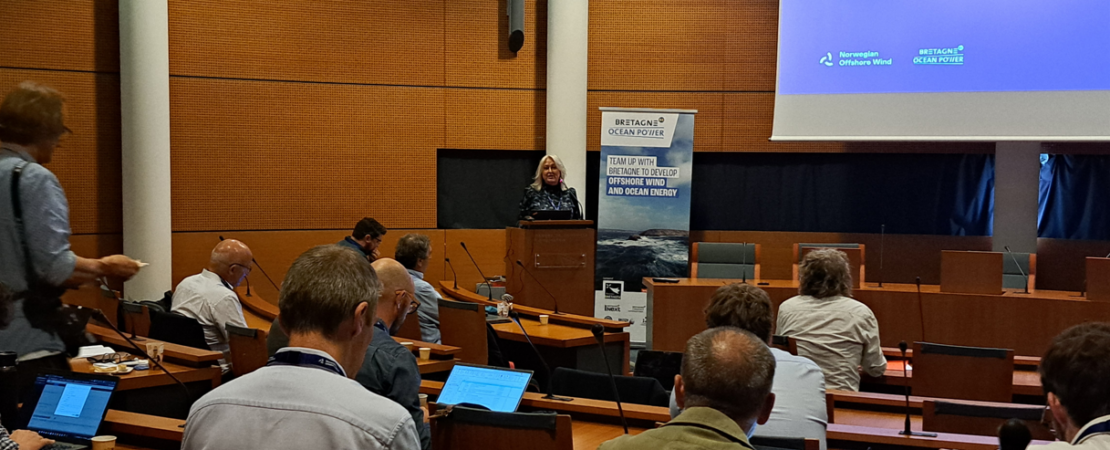
Bretagne Ocean Power and the Norwegian Offshore Wind cluster organized a “Boostcamp” this week at the Port of Brest as part of their partnership agreements. Seven Norwegian offshore wind companies toured the facilities and met with Breton industry stakeholders. Beyond business discussions, the event—coordinated by the Bretagne Next agency—provided an opportunity for Norwegian industry representatives to explore the port infrastructure and expertise of Brittany’s marine renewable energy ecosystem. With more than 200 companies, this sector is booming and could generate up to 11,000 jobs per year by 2050, according to a recent EY study for Bretagne Next. An opportunity for Breton companies to gain access to Norwegian projects as well.
The ORE Brest Terminal: A Showcase of Breton Port Expertise
In particular, the delegation visited the BrestPort ORE terminal: 40 hectares equipped with 380 meters of reinforced docks dedicated to offshore wind power. Recently selected by the French government as part of the national “Ports and Industry of France 2030” call for projects, the Port of Brest is receiving more than 58 million euros in funding to adapt its infrastructure for floating wind power. Future developments at the Port of Lorient were also presented to highlight their advantages for the installation and logistics of mooring systems. These investments position Brittany as the ideal partner for floating wind projects along the Atlantic coast and in the Celtic Sea.
Southern Brittany: Setting Course for France’s first commercial-scale floating offshore wind farm
The meeting also highlighted EDF Power Solutions’ operational and planned wind farms along the Atlantic coast, as well as the Pennavel project—led by the consortium of Elicio, BayWa r.e., and Q ENERGY—which is developing the France’s first commercial-scale floating wind farm off the coasts of Groix and Belle-Île-en-Mer. With a capacity of 250 MW, this wind farm is expected to meet the electricity needs of approximately 450,000 residents and is scheduled to come online in late 2032.
Ifremer and its testing facilities, which are unique in France
Finally, Norwegian companies also had the opportunity to explore Ifremer’s testing facilities in Plouzané. These facilities offer expertise—unique in France—in hydrodynamic modeling for offshore wind energy and the strength of materials in marine environments, as well as the Sainte-Anne du Portzic offshore testing site.
Opportunities for Breton Businesses
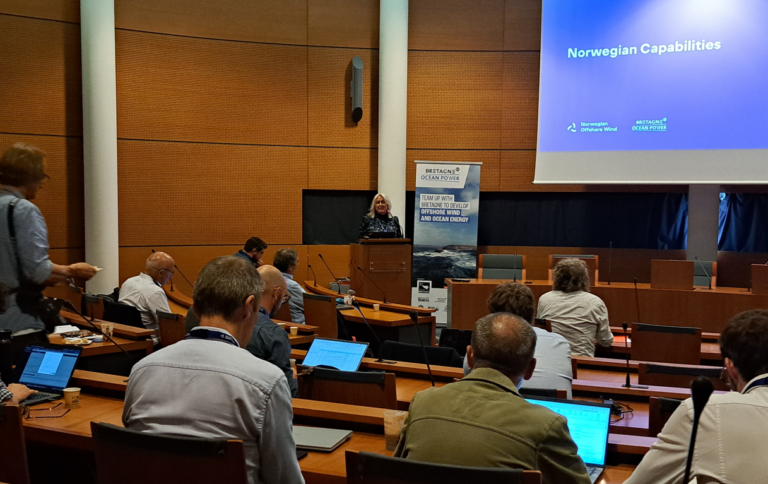
The Norwegian delegation, organized around the Norwegian Offshore Wind cluster, met with representatives of the Breton industry to explore new partnerships in the French and European offshore wind markets. The delegation included Norwegian Offshore Wind AS, ABB, Boa Management AS (BOA Offshore), Tugdock Submersible Platforms Ltd, Offshore & Trawl Supply AS (OTS), OCERGY, and Windstaller Alliance.
 Norway brings world-leading expertise from decades of offshore and maritime industries, giving our member companies a strong position in the development of floating offshore wind. But no country can develop this industry alone. Brittany has a strong maritime and industrial ecosystem, and meeting companies in Brest is an opportunity to connect our complementary capabilities, build partnerships and strengthen the European supply chain for floating offshore wind. We already see several good examples of cooperation and they will be highlighted at the Boostcamp in Brest.
— Astrid Green, Business Development Manager, Norwegian Offshore Wind
For example, the Norwegian company BOA Offshore has already signed a memorandum of understanding (MoU) last October with BrestPort to develop methods for launching floating structures from the Brest terminal. More than 25 Breton companies in attendance expressed interest in forging ties with these Nordic partners and thus becoming involved in international projects that are already underway.