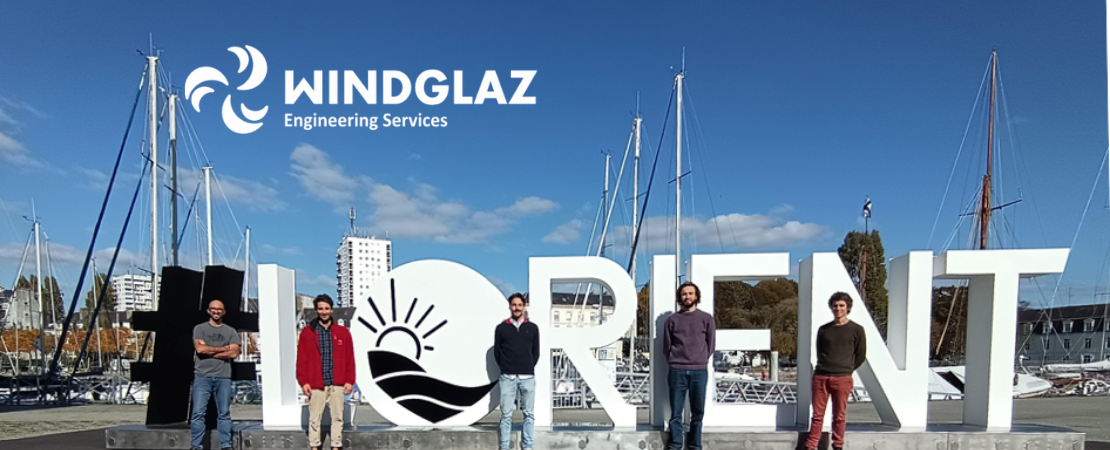
Lorient-based firm Windglaz is a strategic player in the offshore wind sector. Specialised in complex numerical modelling, this Breton gem is supporting some of the leading offshore renewable energy projects, from Brittany’s prototypes to South Korea’s gigantic wind farms. Now part of the DORIS Group, Windglaz is injecting its critical expertise into the Pennavel project. Meet the founder, Cyril Bourgoin.
Can you tell us about Windglaz and the story of how it all began?
At the outset, the team at Windglaz was made up of engineers from Nass&Wind. Antoine Grange and I created Windglaz in late 2018, at a time when Nass&Wind — a long-standing player in offshore renewable and wind sector in France, both onshore and offshore, floating and bottom-fixed— was seeking to home in on other sectors.
The aim behind Windglaz was to pursue the engineering work we had been doing previously: supporting all industry players and foundation developers and designers in the field of offshore renewable energy. We have specialised skills in numerical modelling of these systems with specific tools, strong computational capabilities and almost 16 years of experience in the case of some of our team. Today, Windglaz is part of the DORIS group, which brings us stability and a long-term outlook.
How exactly is the numerical modelling process performed at Windglaz?
We are involved at different stages. The first step is the definition of what is to be simulated: the design briefs. We are often responsible for addressing the aspects relating to environmental conditions. This involves retrieving metocean data and determining the typical sea state, extreme wind, swell or current in the area to assess a system potentially installed at the given site.
We then put forward a modelling schema. We model the turbine (blades, aerodynamic behaviour, structural behaviour, control), tower, floating structure (hydrodynamics, damping) and mooring system. We use a range of tools that we tailor to each project. This stage involves defining and validating the model and interface, and is where we bring the most expertise together with the designer.
Finally, we run these models on a high volume of calculations, in some cases up to 25,000 load cases. These calculations are managed internally. We extract the results (float movements, power generated, tensions in the mooring systems and loadings on the various components) to provide the partners in charge of extreme and fatigue loads with the information they need to design the components.
We are really at the core of the numerical modelling process that assembles input data from all types of offshore renewable players.
What are your competitive advantages on the floating offshore wind market?
Our expertise specifically correlates to the needs of the floating wind sector, which requires new tools compared to bottom-fixed wind:
- Turbine model calibration, which differs between bottom-fixed and floating technologies,
- Advanced hydrodynamic calculations and hydro-structure interactions,
- Mooring calculations,
- Knowledge of standards specific to floating wind,
- Management and use of the results of tank trials.
It is a field in which there is relatively little competition; there are very few companies that do what we do. We are able to offer the latest methodologies and the latest tools, yet our strength lies above all in two elements:
- Our experience in major projects: We have been involved in a number of key projects such as Gray Whale 3 in South Korea, for which we supported DORIS Engineering. Thanks to the experience we have acquired, both positive and negative, we can act as catalysts for new projects. When clients approach us, it is this catalytic role they are seeking.
- Our knowledge of turbines: Through our history with Nass&Wind, we have been responsible for developing turbines. We are therefore capable of filling in for the turbine developer in the preliminary stages, when they cannot yet be brought in, and put forward equivalent turbine models. For certain projects, the manufacturing schedule requires plans for certain components to be produced before the turbine supplier has finalised the last iteration of loads. To comply with this critical scheduling requirement, thanks to our equivalent models, internal integrated load analyses can be performed. With this approach, we can secure design loads upstream and save valuable months on the master schedule.
Projects around the world, from South Korea to back home in France
Windglaz is involved in numerous projects in France and worldwide. Which are the most noteworthy?
We worked on the gravity-based structures for the Fécamp project and on the monopiles for Courseulles-sur-Mer. We were involved in the Groix-Belle-Île prototype and supported Eolink’s projects in Brittany.
Internationally, we have contributed to many projects, including multi-gigawatt projects in the United Kingdom. We were also involved in a project in the Baltic Sea. We also work in floating solar, a major sector with projects across the globe. On Gray Whale 3, in South Korea, we worked together with DORIS Engineering. The Asia-Pacific region is active, and we hope to be able to play a catalytic role in these projects by providing feedback from European projects. And then there is Pennavel, of course.
Can you explain your role in the Pennavel project?
This is an important milestone that rewards several years of hard work. We are based in Lorient, so this project means a lot to us. We personally worked on the Winflo and Groix-Belle-Île projects; it was therefore essential for us to get on board with the adventure in Brittany. We believe that we were identified by Pennavel for our expertise in this specific area of numerical model management.
For Pennavel, our role will be to help them manage the numerical modelling by their various subcontractors. The aim is to ensure that all simulations are performed with the same level of quality and unbiased input data.
In terms of human resources, what are your recruitment needs?
We are always on the lookout for engineers seeking a long-term role. It is not necessarily a job you can learn at school, so we organise a lot of in-house training. Ideally, candidates should have some knowledge of naval architecture.
We have strong ties with the OFFWIND Masters at ENSTA Bretagne. Some of our people are graduates of this Master’s course designed by Jean-Yves Pradillon and now directed by Guilhem Bles. We have engineers who specialised through their studies, but also people from other sectors who have their head screwed on: they did not necessarily know how to perform wave modelling when they first joined us, but today they are fully operational in the tasks we carry out.