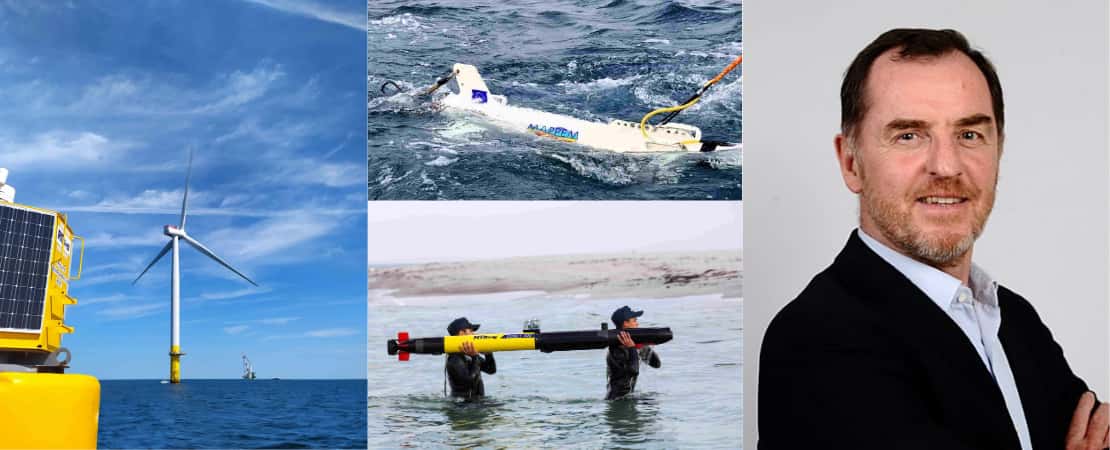
The Sea Vorian group, based in Lorient, Brest, Toulon and Singapore, encompasses three companies – RTsys, Mappem Geophysics and Neotek – specialised in acoustics, electromagnetics and marine monitoring. With its recognised expertise in robotics and underwater measurements, this key partner in offshore renewable energy is firmly rooted in Brittany, while asserting a strong international focus. We spoke to the group’s CEO, François Xavier de Cointet.
Sea Vorian : a Breton group with a maritime focus and an international outlook
Can you tell us about Sea Vorian and its main activities?
Sea Vorian is a group of companies based in Lorient, Brest, Toulon and Singapore. We currently have 110 employees and are on track to achieve a €25 million turnover this year. Our core activity lies in designing and operating innovative products and services to gain a better understanding of what goes on at sea, and especially under the sea.
The group is composed of three companies, each with its specific expertise: RTsys, specialised in underwater passive acoustics and robotics; Mappem Geophysics, experts in marine electromagnetics; and Neotek, which focuses on instrumentation and monitoring. Together, we operate in three main fields: science and the environment, working with research institutes, scientists and consultancies, in particular, in the context of wind energy, to measure the impact of human activities; the maritime industry, working with offshore wind energy and subsea cable specialists; and finally defence and safety, to monitor and enhance knowledge of the marine environment.
We have a strong international focus – from the United States to Singapore – while remaining firmly rooted in France, where our engineering, production and marine operations teams are based.
Comprehensive expertise in underwater measurements
What are the group’s core technical competencies?
We have three main areas of expertise. Recently, through Mappem Geophysics, we added marine electromagnetics, used to take measurements to determine the condition of the seabed, particularly in relation to subsea cable laying.
With RTsys, we operate in the field of underwater robotics. We manufacture AUVs (Autonomous Underwater Vehicles), which can navigate individually or as a swarm to map the seabed. Our second field of expertise, again through RTsys, is passive acoustics, a technology used for underwater listening and positioning, a real area of interest for many of our clients.
We have also developed expertise in marine monitoring with Neotek: we mount sensors on buoys or seafloor observatories, according to our clients’ needs, to measure water quality, swell, turbidity, and many other parameters. We are also able to process and analyse the recorded data.
What aspects of offshore wind energy are you involved in?
We are currently involved in three aspects:
The first relates to our AUVs, which are used to take bathymetric measurements prior to the installation of wind turbines, or to contribute to environmental studies, for example for the Pennavel project off Lorient. Our AUVs are also deployed once the wind farm has been built, to inspect cables and infrastructures throughout their lifetime.
The second aspect is passive acoustics: we deploy buoys with artificial intelligence that measure the noise generated by construction operations in real time, detect marine mammals, and immediately alert the site manager if a threshold value is exceeded.
Finally, with Mappem Geophysics, we are involved in electromagnetics, with towed or stationary systems used to characterise the seafloor to determine the optimal locations for the installation of cables and turbines. We also develop instrumented buoys deployed before or during installation operations, which can take environmental measurements over several months.
Originally, what was the company’s main activity?
We have always struck a balance between civilian and military sectors. Originally, with RTsys, the focus was mainly on passive acoustics in civilian fields. Today, our commercial and technical efforts in the civilian sector, in the areas of wind energy and the environment, are on a par with those in the defence sector. We are still in the demonstration phase in one field – that of subsea cables. In short, we have a fairly balanced spread and a strong international presence.
From R&D to international horizons: a successful shift to offshore energy
Can the different areas of expertise of Neotek, Mappem Geophysics and RTsys be complementary in the field of offshore energy?
Absolutely. We can put forward joint bids for tenders that call for acoustic measurements, environmental measurements and underwater inspection. However, offshore wind generally involves sizeable contracts that are awarded to major groups. We therefore often work as subcontractors to these companies.
Which French-based wind energy projects have you worked on?
We have deployed systems for the projects in Noirmoutier, Saint-Nazaire, Dieppe-Le Tréport and Courseulles. We also operate at the SEM-REV offshore test site and have worked on two wind energy projects in the Mediterranean using passive acoustics.
How did you shift to offshore renewables?
Originally, RTsys started out manufacturing acoustic recorders for scientific clients, before quite quickly expanding to industrial clients. Initially, these acoustic recordings did not allow for real-time monitoring. We then developed buoys capable of issuing live alerts, and later integrated artificial intelligence. We hit a key milestone when we won a contract in the US, deploying our solution on eight buoys. Today, we also have European clients. We have gained worldwide recognition in this field and, as concerns AI, we are probably among the most advanced.
Can you tell us more about your projects in the US?
We are involved in three wind farm projects between Norfolk and New York. We are subcontractors to a major US offshore player, and our systems are closely monitored by the organisation in charge of ocean noise regulation, which is interested in establishing our methods as a reference. For contractual reasons, we unfortunately cannot name our clients, but this is a major operation for us.
What are your links with Bretagne?
We are strongly engaged with Brittany: in the past four years, we have recruited around 50 people, we are building a new production plant here and we champion our local roots and our commitment to Made in France manufacturing.